
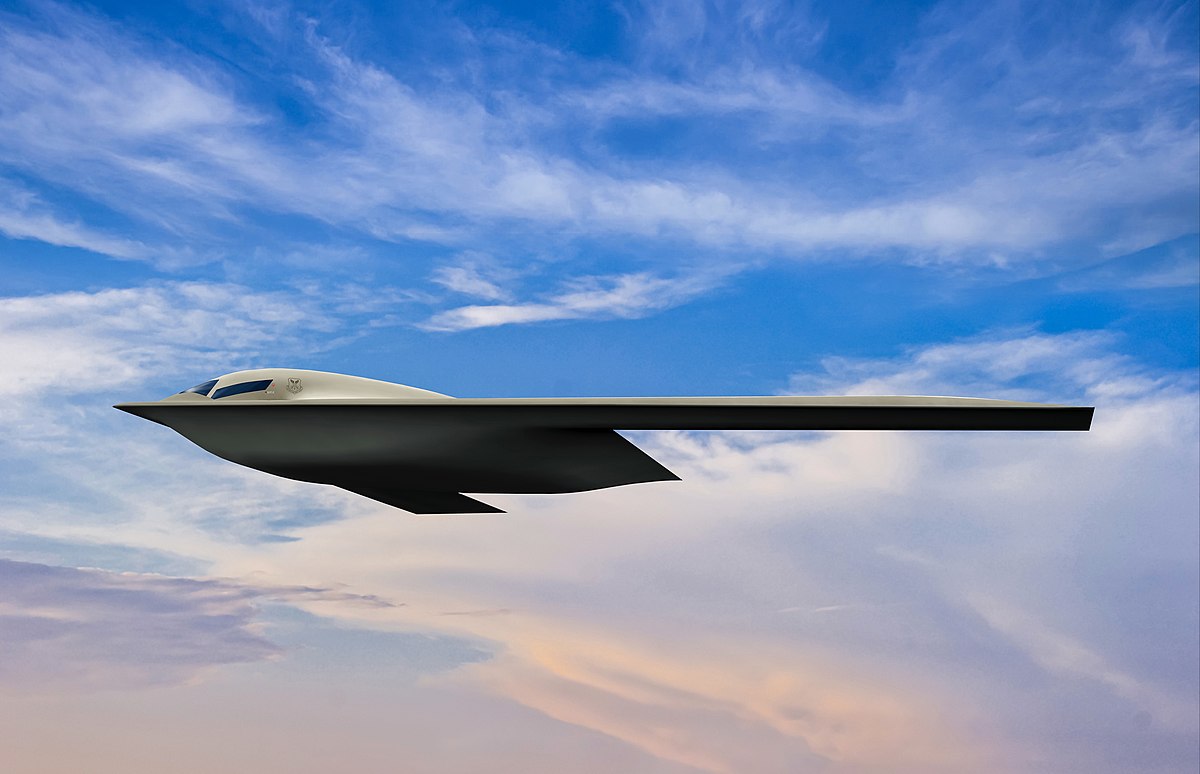

To the left is the H-20 China
To the right is the B-21 Raider American Stealth Bomber


The B-21 Raider: A New Era in Space-Enabled Air Defense
B-21 Raider Unveiled — December 2, 2022
The introduction of the B-21 Raider represents a major transition in U.S. long-range strike and aerospace defense. Unveiled by Northrop Grumman on December 2, 2022, the B-21 is designed as a next-generation stealth bomber capable of operating in increasingly contested airspace.
The designation “B-21” reflects its role as a bomber for the 21st century, while the name Raider honors the Doolittle Raiders, who conducted the historic 1942 raid against Japan during World War II.
A Sixth-Generation Approach
The B-21 is commonly described as a sixth-generation bomber, emphasizing not simply a new aircraft but a broader combat architecture built around connectivity, intelligence, automation, and survivability.
For comparison, the B-2 Spirit was already approximately 34 years old in 2022, while the B-52 Stratofortress had been in service for roughly 66 years. The B-21 is intended to provide a modern platform capable of complementing and eventually replacing portions of this aging bomber fleet.
Beyond the Aircraft
From a space-defense perspective, the B-21 is particularly significant because modern airpower increasingly depends on space-based infrastructure. Long-range strike operations can incorporate satellite communications, positioning and navigation, intelligence, surveillance and reconnaissance (ISR), missile warning, and space-domain awareness.
The Raider is designed around a highly connected battlespace in which information can move between aircraft, satellites, command centers, sensors, and other military platforms.
Key technological concepts associated with the B-21 include:
- Long-range strike capability for operations at extended distances.
- Advanced stealth to reduce detection and improve survivability.
- Integrated ISR to collect and process information from multiple sources.
- Electronic warfare capabilities designed to operate in environments where adversaries employ sophisticated radar and communications systems.
- Advanced computing and artificial intelligence to support decision-making and mission management.
- Advanced sensors and radar for detecting and tracking threats.
- Networked command and control connecting the bomber to the broader joint force.
- Potential integration with future directed-energy technologies as those systems mature.
- Nuclear deterrence capability as part of the U.S. strategic bomber mission.
Why It Matters to Space Defense
The B-21 demonstrates how the boundary between airpower and spacepower is becoming increasingly interconnected. A modern bomber does not operate as an isolated aircraft. Its effectiveness can depend on information generated by satellites and other space-based and terrestrial sensors.
For students studying space defense, the B-21 provides an important case study in multi-domain operations. Future military systems will increasingly combine aerospace platforms, satellites, artificial intelligence, cybersecurity, electronic warfare, autonomous systems, and advanced communications into a single operational network.
The B-21 Raider is therefore more than a new bomber. It is an example of how the U.S. military is evolving toward a network-centric, information-dominant battlespace in which control of data and the ability to protect the systems that generate and transmit that data can be as important as the aircraft itself.
Recent Posts
new Space Economy
Sean Kirkpatrick of AARO Retires after completing Department Investigations
The All-Domain Anomaly Resolution Office (AARO) Director Sean Kirkpatrick, Retires