
Building a Space Defense Publication: An Entrepreneurial Guide to the New Space Economy
The expansion of the commercial space industry has created opportunities far beyond engineering, manufacturing, and launch services. One emerging opportunity is space-focused digital publishing—creating magazines, newsletters, websites, podcasts, and other information platforms that explain developments across the space economy and national security space sector.
For students interested in entrepreneurship, journalism, communications, technology, or space defense, launching a specialized publication can provide practical experience while developing expertise in an increasingly important industry.
Finding Your Space Defense Niche
The space economy is enormous and increasingly global. No individual publisher can realistically cover every launch provider, satellite operator, government program, emerging technology, and commercial market.
The first step is therefore to establish a specific editorial niche.
A publication might focus on:
- Space defense and national security
- Space Domain Awareness (SDA)
- Satellite communications and protection
- Cybersecurity in space systems
- Artificial intelligence and autonomous spacecraft
- Military satellite technology
- Launch systems and reusable rockets
- Space-based intelligence, surveillance, and reconnaissance
- Orbital logistics and servicing
- The commercial space economy
A focused subject makes it easier to establish credibility and develop a consistent readership. A publication devoted specifically to satellite protection, for example, has a much clearer identity than one attempting to cover every aspect of the space economy.
The niche should also have staying power. Technologies change rapidly, so publishers should select subjects broad enough to remain relevant while updating their coverage as new systems and capabilities emerge.
Content Is the Core Product
A successful publication is ultimately built around information. The publisher must determine what subjects belong in the publication and what subjects do not.
For a space-defense newsletter, the strongest content might include technology developments, military space programs, satellite resilience, launch infrastructure, cyber threats, Space Domain Awareness, emerging commercial capabilities, and the changing relationship between government and industry.
Editorial judgment is especially important when covering sensitive or controversial subjects. Space defense involves national security, military operations, emerging technologies, and geopolitical competition. Accuracy, sourcing, context, and responsible reporting should take priority over sensationalism.
Students entering this field should learn to distinguish between verified information, informed analysis, speculation, misinformation, and disinformation. That distinction is becoming increasingly important as artificial intelligence makes it easier to generate convincing but inaccurate material.
Developing an Audience
A publication cannot appeal equally to everyone. Identifying the target audience should happen early in the planning process.
A college-oriented space-defense publication could target students, educators, engineers, cybersecurity professionals, military professionals, policymakers, entrepreneurs, and readers interested in emerging technology.
Different audiences require different editorial approaches. Students may be interested in careers and education, while technical professionals may want deeper analysis of satellite architectures, sensors, communications systems, propulsion, cybersecurity, or orbital mechanics.
General-interest articles on rockets, satellites, spacecraft, and space stations can provide broad appeal while specialized articles establish technical credibility.
Designing the Digital Publication
Unlike traditional print magazines, an online publication eliminates many printing and physical distribution costs. However, digital publishing introduces its own expenses and technical requirements.
Potential costs include:
- Domain registration
- Web hosting
- Bandwidth
- Website development
- Search Engine Optimization (SEO)
- Search Engine Marketing (SEM)
- Digital advertising
- Graphic design
- Video production
- Email distribution
- Analytics and audience-management tools
A startup publication does not need to purchase every service immediately. Entrepreneurs can begin with a simple website and expand infrastructure as readership grows.
The publication might appear as an HTML website, downloadable PDF, electronic magazine, email newsletter, or combination of formats. Social-media platforms, podcasts, and video channels can further expand the publication’s reach.
Visual Communication and Copyright
Presentation influences whether readers stay with an article. Space publishing has an advantage because spacecraft, rockets, satellites, launch facilities, and orbital operations provide highly visual subjects.
However, publishers must understand copyright and licensing. Images should come from authorized sources, public-domain collections, government sources where appropriate, or properly licensed commercial image libraries. Required attribution and licensing conditions should always be followed.
Students entering digital publishing should treat intellectual-property management as part of the publishing process rather than an afterthought.
Editorial Judgment and Timeliness
Not every story belongs in every publication.
Monthly and quarterly publications are not designed to compete directly with breaking-news organizations. Instead, they can provide analysis, background, technical explanation, and broader context.
Controversial topics can attract readership, but controversy should never replace evidence. A professional publication should clearly distinguish reporting from opinion and analysis.
For a college space-defense newsletter, the goal should be to educate readers about complex developments without sacrificing technical accuracy or editorial independence.
Building the Business Model
Creating a publication requires time and resources, so entrepreneurs should develop a sustainable financial model.
Potential revenue sources include:
- Paid subscriptions
- Membership programs
- Digital advertising
- Sponsorships
- Affiliate marketing
- Educational products
- Research reports
- Consulting services
- Courses and training
- Events and conferences
Advertising can become particularly valuable once a publication develops a well-defined professional audience. Aerospace companies, software companies, satellite manufacturers, launch providers, educational institutions, and other organizations may have an interest in reaching specialized space audiences.
The key metric is not simply the number of subscribers. Advertisers and sponsors increasingly care about audience quality, engagement, demographics, professional relevance, and measurable results.
Distribution Is Part of the Strategy
A good publication needs a distribution strategy before its first issue is released.
Potential distribution channels include websites, email newsletters, LinkedIn, YouTube, podcasts, professional organizations, student organizations, blogs, online communities, and industry partnerships.
Backlinks from established websites and mentions from influential organizations can also improve search visibility and establish credibility.
A small publication can begin with several hundred engaged readers and gradually build toward thousands. A smaller, highly specialized audience can sometimes be more valuable than a much larger general audience because the publication provides information to people with a specific professional or educational interest.
Designing the Publication
Layout is another important component of digital publishing. A publication should establish a consistent visual identity, including typography, graphics, headlines, photographs, charts, and navigation.
Traditional magazines often use two- or three-column layouts, while digital publications can take advantage of responsive web design, interactive graphics, video, hyperlinks, and data visualizations.
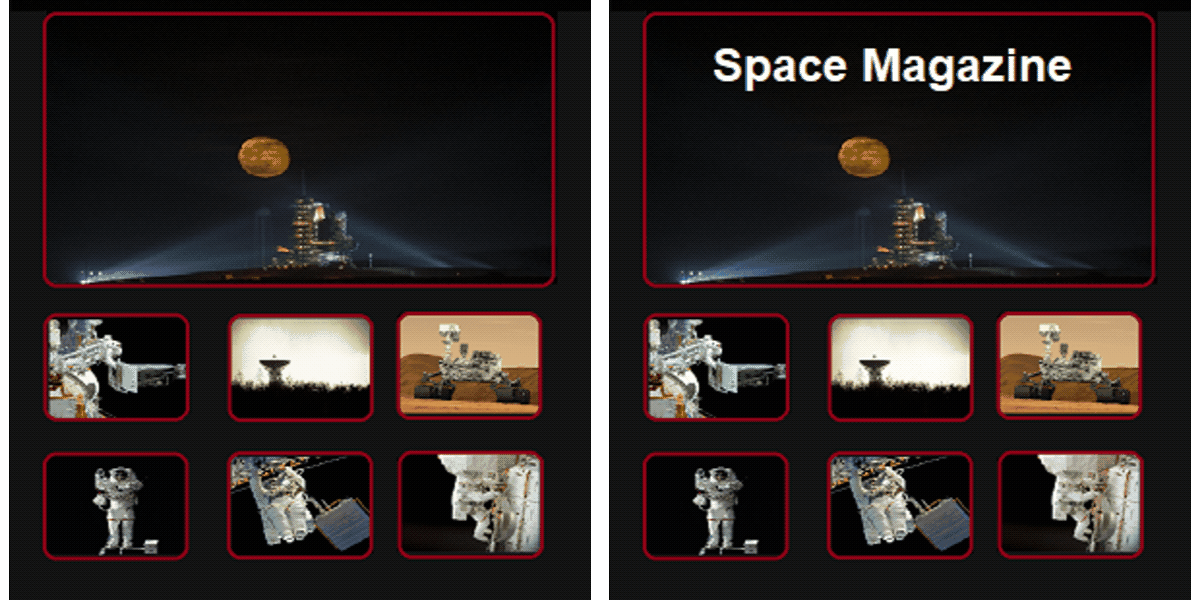
Creating a mock issue before approaching advertisers or sponsors can be especially useful. A finished demonstration issue shows potential partners what the publication looks like, who it is intended for, and what type of content they would be supporting.
Start Small and Build Expertise
Launching a space-defense publication does not require a large newsroom. A student or entrepreneur can begin with a narrowly defined subject and a manageable publishing schedule.
An initial target of several hundred subscribers can provide an opportunity to learn about editorial planning, research, digital marketing, audience analytics, graphic design, distribution, and revenue generation.
Over time, the publication can expand into additional subjects and platforms.
The most important lesson is that publishing is not simply about producing articles. It is about building an information system around a specialized audience.
For students entering the space-defense field, that process can provide more than entrepreneurial experience. It can become a practical education in the technologies, organizations, markets, policies, and security challenges shaping the next generation of space operations.
The Space-Defense Entrepreneur
The emerging space economy needs engineers and scientists—but it also needs researchers, analysts, educators, journalists, software developers, entrepreneurs, and technical communicators who can explain increasingly complex space systems to a broader audience.
A specialized digital publication can therefore serve as both a business venture and a professional development platform. Start with a focused niche, establish editorial credibility, build an audience, and expand as your expertise and resources grow.
In the new space economy, information itself is becoming an important part of the infrastructure.
Recent Posts
new Space Economy
Sean Kirkpatrick of AARO Retires after completing Department Investigations
The All-Domain Anomaly Resolution Office (AARO) Director Sean Kirkpatrick, Retires